Multi-Tap Calculator
A free, open-source tool for apportioning taps on an inductor.
A free-running calculator for ratiometrically locating taps on an inductor. One with which you can haggle to get exactlty just what you want. And do it without tediously enduring a series of one-shot do-overs.
|
|
My LabVIEW calculator will only be as accurate as the AL value which you provide it. Many a toroid have tolerances of ±25%.
|
|
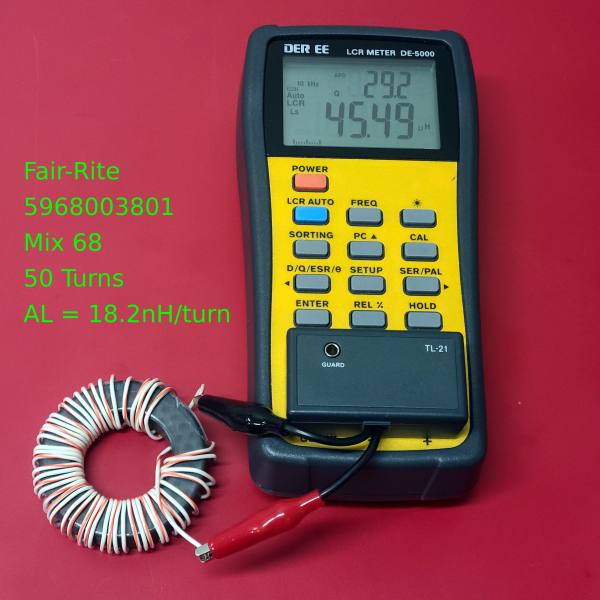
Above you see the example of Fair-Rite model l5968003801, whose AL lists as minimum 16nH/turn. Directly measuring 50 turns at 10kHz with an LCR Meter, I find it to have actually 18.2nH/turn.
You may need to haggle to get exactly just what you want. In the screenshot at top, my design constraints were as below:
250nH
50uH
38
And, as you can see, I obtained those values very closely indeed. And with the taps spaced both ratiometrically, (as only makes sense), and also conveniently (always at an easily identifiable cross-sectional flat or corner).
The haggling steps went as follows...
AL got by measuring my toroid of choice.Turns (N) control until the readout L (H) showed just above 50u.34 as my desired number of taps.Taps (N) agreed, showing 34.Tap 1 at 1.125 turns gave only 23.034n.
Min (H) for 250n.
Taps (N) to fall short of 34.Taps (N). As it will continue to do from this point on, but which I will ignore.Taps (N) until the readout Taps (N) showed 34.
You’ll need two things for it to run: my *.exe application itself, plus also the interpreter program on which it runs. Kind of like Java that way, except that the Java interpreter is probably pre-installed on your system. The LabVIEW run-time engine will not be.
ky8d.net/free where I give download instructions.*.exe file. Employ a stand-alone ZIP archive software (like 7-Zip ) for the extraction.